
Reliance Industries commands enormous weight in India’s corporate ecosystem. It spans oil & gas, refining, petrochemicals, telecom/digital (Jio), retail, and increasingly, green energy. Its footprint means that its balance sheet is not merely a static statement of accounts, but a lens into India’s industrial ambition, capital allocation choices, and resilience to external shocks.
In this article, we dig into the consolidated balance sheet as of March 31, 2025 (latest audited) from RIL’s integrated annual report, cross-referencing disclosures and market data. Our aim: to understand how Reliance is financed, where the risks lie, and whether the structure supports the growth dreams ahead.
Key Figures at a Glance
Before deeper analysis, here are some headline numbers (₹ in crores) from the March 2025 consolidated balance sheet:
- Total Assets (and Liabilities + Equity): ₹1,950,121 crores (approx.)
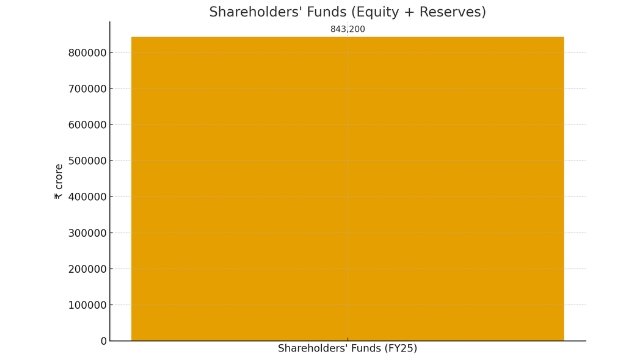
- Shareholders’ Funds (Equity + Reserves): ₹843,200 crores.
- Total Borrowings / Long-Term Debt (gross): From long‐term borrowings ~ ₹236,899 crores (for example) plus current maturities and other debt portions.
- Other Liabilities (trade payables, accruals, provisions, deferred liabilities): a very large component in the mix.
- Deferred Tax Liabilities (Net): ~ ₹83,453 crores in 2025.
- Current Liabilities (payables + others): for context, current liabilities run in the range of ₹181,493 crores or more (depending on the year).
- Capital Work in Progress, Fixed Assets, Investments & Other Assets: heavy in fixed capital, plus subsidiary / associate investments and financial assets. (Detailed in the annual report).
These numbers alone show the sheer size and complexity of Reliance’s balance sheet. It is a mammoth structure, with a mix of capital, liabilities, and operating obligations that require careful reading.
Asset Side: Where the Capital Is Deployed
Understanding how Reliance has deployed its capital is the first step to assessing risk and return.
1. Fixed Assets & Capital Work in Progress (CWIP)
A dominant chunk of Reliance’s asset base is in fixed assets (plants, machinery, pipelines, infrastructure) and CWIP (ongoing capital projects). Given RIL’s projects, from refining complexes, petrochemical plants, pipelines, energy/renewables infrastructure, this is expected. The ratio of gross blocks and CWIP relative to total assets is high.
But having many assets under construction or in commissioning is a double-edged sword: delays, cost overruns, regulatory challenges, and concrete execution risk are real. Returns on fresh capex often take years to fully flow.
2. Investments, Associates & Financial Assets
Reliance holds substantial stakes in subsidiaries, strategic investments, and financial instruments (equity, debt, marketable securities). These give optionality: it can divest, monetize, or reconfigure holdings if needed. These assets are more liquid and can act as cushions in stress.
The annual report lists such investments and inter-group loans; reading those footnotes provides clarity on what portion is “monetizable vs strategic non-liquid.”
3. Current Assets: Inventory, Receivables, Cash
Reliance must carry inventories (raw materials, intermediates, finished products) given the petrochemical and refining nature. Receivables arise from sales to customers and trade receivables in retail or industrial segments. Cash and equivalents, and short-term financial assets, also form part of current assets.
One must watch for inventory aging, obsolescence risk (especially in chemicals), receivables days, and how aggressive provisioning is. If inventory stacks up unsold or receivables become sticky, that can erode value.
In sum: the asset side is “capital heavy + optional investments + working capital.” Managing the working capital efficiently, keeping the fixed assets productive, and ensuring investments do not become stranded are central challenges.
Liability & Capital Side: How It Is Financed
Next, we see how Reliance raises money and meets its liabilities.
1. Borrowings / Debt Structure
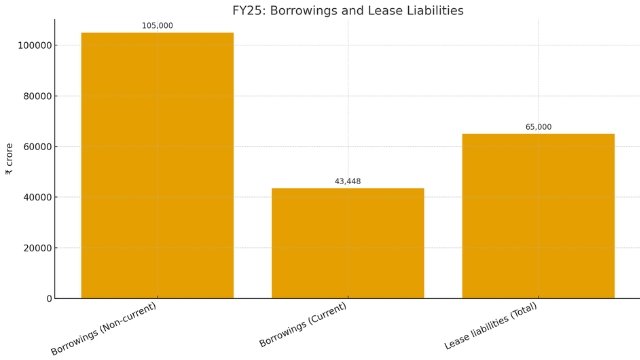
Debt in the form of long-term borrowings, current maturities, and working capital loans is significant. In FY 2025, long-term borrowings stood at around ₹236,899 crores, compared with approximately ₹222,712 crores in FY 2024. But that is only part of the picture, when short-term debt and current maturities are included, the total debt burden becomes considerably higher.
Reliance also issues corporate debt and notes, and uses revolving credit facilities. The interest rate environment matters deeply. Any upward move in interest rates globally or domestically will impact interest costs.
One helpful disclosure is that in its 4Q FY25 analyst presentation, RIL emphasizes “maintaining strong balance sheet and flexibility” as a goal.
What matters is not just the absolute debt, but:
- Debt as a proportion of equity or total capital
- Debt maturities (how much is due in the near term)
- Effective interest rate / average cost of debt
- Covenants and restrictions (which the annual report may impose)
- Whether the debt is secured or unsecured
From media release: in the audited consolidated balance sheet note, RIL discloses debt and maturities.
2. Other Liabilities
Trade payables, accruals, provisions, deferred liabilities, and long-term other liabilities (e.g., contracts, warranties, decommissioning obligations) form a heavy load.
For instance, the company’s financial statements show “Other Long-Term Liabilities” of approximately ₹138,102 crores as of 2025.

Deferred tax liabilities net are approximately ₹83,453 crores as of 2025.
These elements matter because they aren’t explicit “financing” that management chooses over equity or debt, they are structural obligations arising from operations, regulation, taxation, and contracts.
3. Shareholders’ Funds / Equity Base
Reliance’s equity base is substantial. Share capital is small relative to reserves/retained earnings. The reserves (retained earnings, other reserves) form the cushion against losses, write-downs, and volatility.
With share funds of ~ ₹843,200 crores (for the consolidated entity), Reliance has significant capacity to absorb shocks, which provides comfort to lenders and shareholders alike.
4. Capital Structure Observations
If you compute a rough leverage ratio (debt / total capital), the debt component is moderate. Equity plus reserves dominate. This suggests Reliance has not overleveraged itself, even while running multiple capital-intensive businesses.
But the devil lies in the details: high short-term debt, large near-term maturities, interest cost escalation, or aggressive working capital could stress this structure.
Also, the existence of large “other liabilities” means that even if direct debt is manageable, obligations not directly labeled as “debt” can bite.
Ratio Analysis & Red Flags
To assess the health of the balance sheet, here are the critical ratios and warning signs.
1. Debt / Total Assets (Gross Leverage)

Taking borrowings in context, debt is perhaps in the vicinity of 12–20% of total assets (depending on how current debt is counted). That is moderate for an industrial/commercial conglomerate.
This isn’t low, but it isn’t dangerously high either, provided earnings remain stable and interest rates remain manageable.
2. Net Leverage & Equity Cushion
Net leverage (debt minus cash) would be lower because of cash and liquid assets. The large equity base gives Reliance a buffer against downside, which is critical in cyclical sectors.
3. Current Ratio / Working Capital Cycle
We should check current assets vs current liabilities. If current liabilities exceed current assets consistently (i.e., negative working capital), the company is depending heavily on supplier credit or revolving debt support. That can be risky if credit tightens.
Historically, Reliance has at times shown negative working capital (i.e., payables outpace receivables + inventories) because of strong bargaining power with suppliers. But that only works if suppliers continue to trust the group. A sudden contraction in supplier credit could skew cash flows.
4. Interest Coverage & Debt Servicing
Crucially, operating profits must be adequate to cover interest payments, principal repayments, depreciation, and capex. In an adverse commodity cycle or margin compression, that buffer could thin quickly.
Though the balance sheet doesn’t show P&L, one must align it with profitability data to see how many times interest is covered (EBIT / interest, or EBITDA / interest). If coverage falls below, say, 2x to 3x, alarm bells start ringing.
5. Asset Utilization & Return on Capital Employed (ROCE)
Because many assets are large and long-lived, lower utilization, regulatory constraints, overcapacity, or delayed ramp-up can lower return on capital. If RIL invests aggressively in green energy, telecom, or infrastructure, those assets must generate returns fast enough. Otherwise, the carrying value may become a drag.
6. Contingent and Off-Balance Sheet Liabilities
These are critical, especially in energy, infrastructure, and chemical sectors. Guarantees, litigation exposure, environmental liabilities, decommissioning obligations, and joint venture commitments all must be probed in footnotes. Sometimes, a large contingent liability, if crystallized, can erode net worth materially.
Impairment risk, particularly for intangible assets, goodwill, or assets in low-margin divisions, is another factor. Management must test goodwill/asset recoverability carefully (and disclose the assumptions).
What the Latest Year Disclosures Tell Us
Looking into the recent 2024-25 disclosures provides nuance.
- The audited consolidated balance sheet as of March 31, 2025 is published in RIL’s media release/report.
- The report shows growth in borrowings (from 2024 to 2025).
- The firm points out in its financial results presentation that it aims to maintain a “strong balance sheet and flexibility.”
- On the revenue / operational side, RIL posted consolidated revenue of ₹1,071,174 crores for FY 2025.
- The balance sheet shows that deferred tax liabilities are material (~ ₹83,453 crores in 2025).
- Also, “Other long-term liabilities” are significant (138,102 crores) in 2025, indicating contractual, legal, or structural liabilities beyond simple debt.
From these, we see that the company is growing its debt, yet still emphasizing balance sheet strength. The growth in liabilities likely aligns with capital projects, expansions, acquisitions, or working capital stress from growth.
There is also a clear intent: management wants flexibility, not a rigid capital structure. That suggests they expect to raise or manage capital actively (through borrowing, divestments, etc.).
One should also note: in recent Q1 FY26, the consolidated net profit jumped ~78% YoY to ₹26,994 crores, driven partly by one-time gains (e.g., stake sale in Asian Paints). This underscores that one-off items can influence net margins and distort operating trends. Users of balance sheet metrics must therefore adjust for such anomalies when analyzing leverage, coverage, etc.
Strengths That Emerge from the Balance Sheet
From this detailed look, a few strengths stand out clearly:
- Scale and Diversification: The sheer size and spread of operations allow Reliance to spread risk. Underperforming segments can be offset by other arms (retail, telecom, energy). The balance sheet supports this multi-pronged exposure.
- Financial Cushion: The strong equity reserve provides a buffer. In an adverse scenario, this cushion gives headroom before invoking distress.
- Borrowing Discipline (so far): Debt is growing, but not explosively. Management seems to be keeping debt in check relative to capital and not letting leverage run loose.
- Optionality via Investments / Holdings: The non-core investments and stakes give flexibility, they can be sold or monetized to release capital or pay down debt if needed.
- Ability to Raise Fresh Capital: Because of its scale, market reputation and credit profile, Reliance is more likely to be able to access debt markets, equity markets, or structured financing (asset-backed, securitization) when needed.
Key Risks & Things to Watch
But the balance sheet also reveals stress points. Investors, analysts, and stakeholders should monitor these:
- Exposure to Interest Rate Shocks: If interest rates rise sharply, debt cost could spike. Even if the debt is moderate, the interest burden could eat into earnings.
- Execution Risk in Capex / Projects: Many assets are still under construction or ramping. Cost overruns, delays, regulatory changes, or permitting issues can derail returns.
- Working Capital Crunch: If supplier credit tightens or if payables must be shortened, the negative working capital model (if present) may backfire.
- Asset Write-downs / Impairment: In downturns, if assets underperform expected returns or become stranded (especially in energy/chemicals/renewables), write-downs may hit equity sharply.
- Contingent Liabilities & Guarantees: Unfavorable rulings, environmental liabilities, guarantees to joint ventures/associates, if triggered, these can morph into real liabilities.
- Concentration Risk: Some operations (like the Jamnagar refinery, pipeline infrastructure, energy assets) are concentrated. Disruption, regulatory clampdowns, and supply chain shocks could disproportionately affect the consolidated entity.
- Commodity & Feedstock Volatility: Because many operations depend on crude oil, natural gas, feedstock imports, exchange rate swings, global cyclical demand, any adverse swing in input costs or demand could stress profitability and, in turn, weaken coverage of debt.
- Leverage in Near-Term Maturities: If a large portion of debt is maturing soon, refinancing risk looms. If credit markets tighten, refinancing on favorable terms may not be possible.
Strategic Implications & Forward View
Given what the balance sheet shows, what should we expect as strategic direction, and how might the capital structure evolve?
1. Capital Allocation Will Be Key
Reliance is investing aggressively in next-generation business lines: renewable energy, green hydrogen, advanced materials, energy storage, and digital infrastructure. The balance sheet must support these new bets without destabilizing the core businesses.
Management will need to be judicious: which projects get capital first, how much external capital is used versus internal funding, and where to divest or monetize.
2. Optimize Working Capital & Cash Flow Efficiency
Given the size of trade payables and receivables, optimizing working capital is a free lever to generate liquidity. Any improvements in turnover, better credit terms, and tighter inventory management can reduce reliance on debt.
3. Use of Non-Debt Financing & Structured Deals
To reduce leverage stress, Reliance may increasingly lean on nontraditional financing: sale-and-leasebacks, securitization of future cash flows, joint venture capital, infrastructure bonds, or project-specific funding. The line between “on-balance” and “off-balance” financing will blur.
4. Maintaining Credit Ratings & Debt Flexibility
To keep interest spreads low and borrowing flexibility high, the company will need to maintain healthy coverage ratios, capital structure discipline, and transparent financials. Any sign of weakening may lead to credit downgrades.
5. Stress Testing & Scenario Planning
Given the volatility in energy cycles and regulatory regime changes (in India or globally), RIL must model stress scenarios (sharp drop in margins, input cost surge, demand shock). The balance sheet should be able to absorb several adverse quarters without triggering distress.
6. Prudent Monetization of Investments
Some investments might not be core to future strategy; the company could liquidate or stake-sell them to raise capital or reduce debt. But such moves must be timed well, poor timing can crystallize losses.
Final Thoughts
Reliance Industries’ latest consolidated balance sheet is formidable, complex, and full of signals. It reflects a company that is both deeply capital-intensive and ambitious, with one foot in legacy sectors (oil, refining, petrochemicals) and the other in high-growth / transition areas (digital, retail, renewables).
Its balance sheet reveals strengths: a large equity cushion, moderate leverage (as of now), diversified investments, and flexibility to raise capital. But it also flags risks: interest rate exposure, execution risk in new projects, contingent liabilities, working capital pressures, and sensitivity to commodity cycles.
Going forward, success will depend not just on what assets RIL holds, but how wisely it manages debt, allocates capital, anticipates forced write-downs, and maintains liquidity. The balance sheet is not static, it will evolve as Reliance’s ambition to double or triple in size meets real constraints of finance, risk, and execution.
Disclaimer:
This article is intended solely for information, education, and general analysis of publicly available financial statements. It should not be treated as financial, investment, trading, or professional advisory. The balance sheet figures, ratios, and interpretations presented here are based on disclosures available at the time of writing and may change with updated filings or revisions from the company. We are not registered with SEBI, RBI, IRDAI, or any financial regulatory authority.
Readers should perform their own research and consult a certified financial advisor, auditor, or investment professional before making any financial decisions related to Reliance Industries or any other company. The analysis provided here is not a recommendation to buy, sell, or hold any security.