
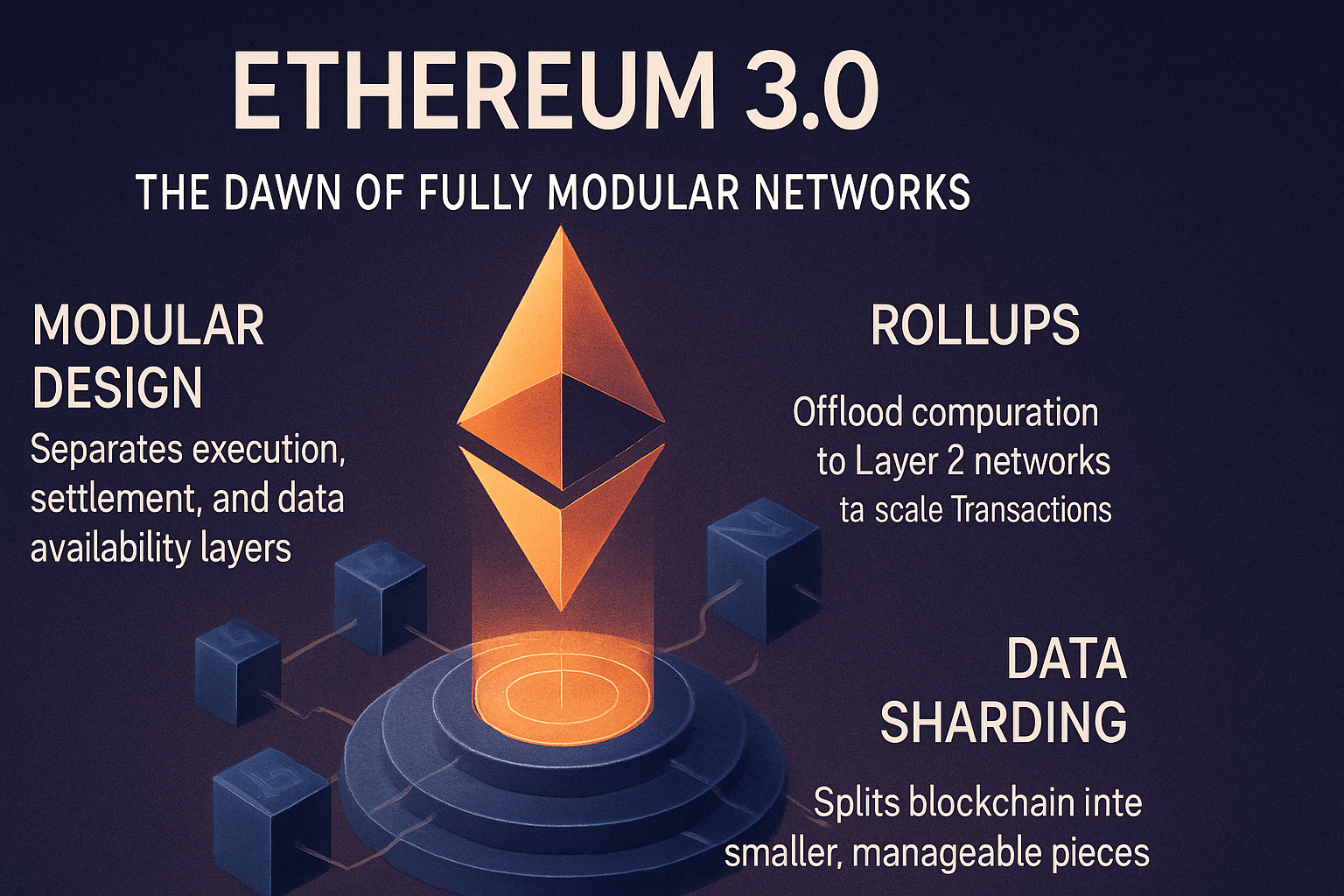
The evolution of Ethereum has reached its most transformative phase yet — Ethereum 3.0. After years of iterative upgrades, Ethereum now stands as a fully modular blockchain ecosystem, separating execution, settlement, and data layers to achieve unprecedented scalability and efficiency.
This major step comes after the successful rollout of the Dencun Upgrade and the global adoption of Layer-2 rollups, cementing Ethereum’s role as the backbone of decentralized innovation.
From Monolithic to Modular: What Changed?
Traditionally, blockchains like Bitcoin and early Ethereum handled execution, settlement, and data storage in a single layer — a model that limited scalability. Ethereum 3.0 introduces a modular design, where these functions are distributed across specialized layers:
-
Execution Layers: Where transactions occur (e.g., Arbitrum, Optimism).
-
Settlement Layers: Where results are finalized and verified on Ethereum’s mainnet.
-
Data Availability Layers: Storing transaction data efficiently via sharding.
This separation allows Ethereum to scale horizontally, improving performance without sacrificing decentralization or security.
The Rise of Rollups
Rollups have become the heroes of Ethereum’s scaling strategy. They bundle thousands of transactions off-chain and submit a single compressed proof to the mainnet — dramatically reducing gas fees.
Leading rollup ecosystems such as zkSync, Arbitrum, and Optimism have matured into thriving sub-networks, each processing more daily transactions than Ethereum’s base layer itself. Together, they push Ethereum’s total throughput beyond 250,000 transactions per second (TPS).
The modular structure enables rollups to innovate independently while maintaining security through Ethereum’s core consensus — a synergy that defines Ethereum 3.0’s strength.
Data Sharding: The Backbone of Speed
The introduction of data sharding marks another major leap forward. By splitting the blockchain’s data layer into multiple shards, Ethereum drastically reduces congestion and accelerates transaction confirmation times.
This architecture allows developers to deploy decentralized applications (dApps) that can handle millions of users without network slowdowns. Combined with rollups, sharding ensures that Ethereum remains affordable, scalable, and future-proof.
The Environmental and Technical Edge
With its proof-of-stake (PoS) consensus already reducing energy consumption by over, Ethereum 3.0 continues to lead sustainability efforts in blockchain.
The modular system further improves network efficiency, as each layer optimizes for a single function rather than performing every role simultaneously. The result? Faster, cleaner, and cheaper transactions that align with global green computing goals.
Real-World Impact and Innovations
The Ethereum 3.0 ecosystem is unlocking new use cases across industries:
-
DeFi Protocols are using modular chains to optimize yield farming and liquidity routing.
-
NFT Platforms now deploy on L2s, offering gas-free minting at scale.
-
Enterprise Blockchains are integrating private rollups to ensure compliance and privacy.
-
Cross-chain bridges are becoming more secure, connecting modular ecosystems seamlessly.
These innovations reinforce Ethereum’s dominance as the digital infrastructure of Web3.
Conclusion
Ethereum 3.0 isn’t just an upgrade—it’s the redefinition of blockchain architecture. By separating its core components into specialized, interoperable modules, Ethereum achieves the holy trinity of scalability, security, and decentralization.
As developers, investors, and enterprises converge on this new framework, Ethereum continues to lead the blockchain revolution powering the next generation of decentralized finance, identity, and innovation.