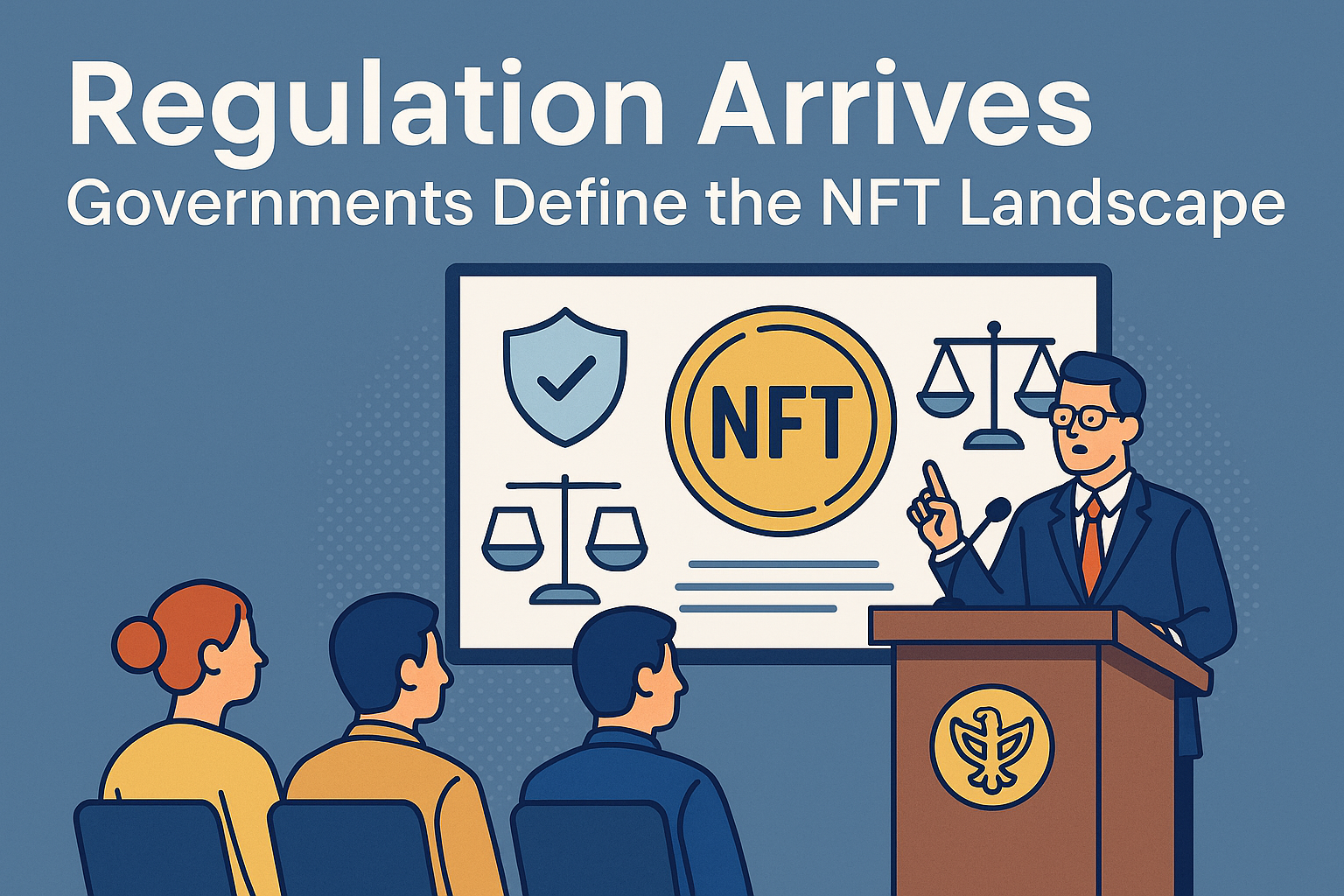
After years of uncertainty, 2025 has become the year of NFT regulation. Governments across the globe have moved to establish clear frameworks that define what NFTs are, how they can be traded, and how creators are protected.
These new rules are bringing legitimacy and structure to a market that was once volatile and misunderstood. For creators, collectors, and businesses, the regulatory clarity is a sign that the NFT industry is entering its most stable and mature phase yet.
The Push for Clarity
In the early NFT boom, markets were flooded with speculative assets and unclear ownership rights. Fraud, wash trading, and intellectual property disputes became rampant. Regulators could no longer ignore the rapid growth of the NFT ecosystem, which had crossed $40 billion in transaction volume by late 2024.
To address this, key regions such as the United States, European Union, and Singapore began issuing legal guidelines that distinguish between NFTs used as collectibles, securities, or utility tokens. This classification ensures that NFTs are treated according to their function, not just their form.
The U.S. and European Approach
In the United States, the Securities and Exchange Commission (SEC) and Commodity Futures Trading Commission (CFTC) now work in tandem to regulate tokenized assets. Collectible NFTs remain exempt from securities law, while fractionalized NFTs or those offering revenue sharing are treated as investment instruments.
Meanwhile, the European Union introduced NFT provisions under its MiCA (Markets in Crypto Assets) framework, which took effect in 2025. MiCA focuses on consumer protection, ensuring NFT marketplaces meet transparency and data disclosure standards.
These frameworks have given both creators and investors legal confidence — a key step toward mainstream adoption.
Asia’s Balanced Regulation
Asian markets have taken a pragmatic stance. Japan and South Korea have rolled out NFT-specific licenses for marketplaces, ensuring compliance with anti-money laundering (AML) and consumer safety standards. Singapore’s Monetary Authority has gone further, creating a sandbox environment for NFT startups to test products before public release.
This flexible regulatory model encourages innovation while minimizing risk — a balance that has made Asia one of the most dynamic NFT regions in the world.
How Regulation Benefits the Industry
Contrary to early fears, regulation has not stifled NFT innovation. Instead, it has:
-
Reduced fraud by enforcing identity verification on marketplaces.
-
Strengthened intellectual property rights for artists and brands.
-
Increased institutional participation by offering legal certainty.
-
Encouraged tax clarity for NFT sales and royalties.
Major platforms such as OpenSea, Magic Eden, and Rarible have embraced compliance frameworks, integrating transparent royalty systems and KYC processes for creators and traders.
Institutional and Corporate Adoption
With regulation in place, institutional investors are finally entering the NFT space. Hedge funds and private equity firms are now tokenizing art, real estate, and even music royalties under compliant structures.
Corporations are also leveraging NFTs to authenticate luxury goods and manage supply chains, now that ownership tracking has clear legal backing. The blend of law and blockchain has made NFTs not just collectibles but legitimate business assets.
The Future of Legal NFTs
Looking ahead, global cooperation on NFT standards will become crucial. International organizations are exploring interoperable frameworks that ensure NFTs created in one jurisdiction can be legally recognized in another.
Emerging fields such as AI-generated NFTs and fractionalized ownership will bring new challenges, but the foundation laid in 2025 ensures the ecosystem can adapt.
Conclusion
The arrival of NFT regulation marks the end of the wild west era and the beginning of a sustainable digital economy. Governments, creators, and investors are now working together to shape an industry that balances innovation with accountability.