
India’s economic narrative in 2025 stands at an inflexion point. What was once a developing-market growth story is now evolving into a powerful example of a self-sustaining, domestic-demand–driven economy. Amid global volatility, interest rate uncertainty, and geopolitical tensions, India continues to exhibit remarkable resilience, powered overwhelmingly by its own people, their investments, their consumption patterns, and their confidence in the nation’s future.
While foreign capital continues to play a role, the real force multiplier is domestic capital. From mutual funds to retail investing, from consumer demand to institutional inflows, India is demonstrating that strong nations grow from within.
This expanded analysis explores the powerful dual engine fueling India’s 2025 trajectory:
(1). Household and institutional investments, and
(2). Strong domestic consumption across Tier-1, Tier-2 and Tier-3 regions.
1. India’s Retail Investment Boom: Mutual Funds Leading the Way
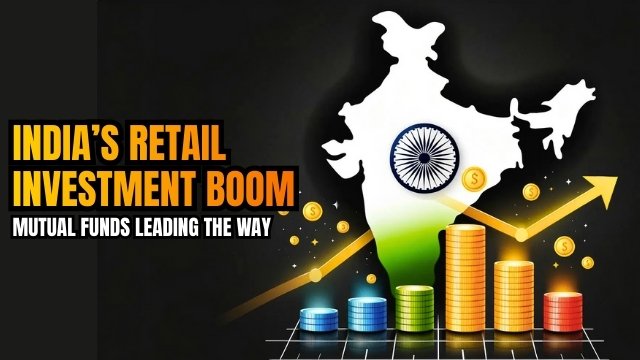
By September 2025, India’s mutual fund landscape reached a historic milestone:
| Metric | 2024 | 2025 | YoY Growth |
|---|---|---|---|
| Total Mutual Fund Folios | 21.0 crore | 25.19 crore | ~20% |
| New Folios Added in One Month | – | 30 lakh+ | – |
| SIP Monthly Inflow | ₹17,000 crore | ₹20,300 crore | 18% growth |
| Retail Participation Share | 56% | 61% | Rising steadily |
Why This Boom Matters
More than 4.14 crore new folios were added in FY 2024–25 across equity, hybrid, and passive funds.
This indicates widespread retail participation and a shift in how households engage with financial markets.
The rise of low-cost passive investing and index funds has democratized wealth creation.
Such options make it easier for first-time investors to enter markets without deep financial knowledge.
Middle-class investors are increasingly opting for systematic investment plans (SIPs), making retail inflows more stable and long-term.
This adds predictability to market inflows and strengthens India’s market depth.
This shift signals something profound:
India’s household savings are now channelled into productive assets, reducing dependency on gold, real estate, and unorganised savings instruments.
A more productive allocation of capital accelerates economic growth and strengthens financial systems.
Structural Impact
1. Encourages long-term capital formation
This means Indian companies gain access to patient capital that supports expansion and innovation.
2. Deepens India’s financial markets
A wider investor base reduces concentration risk and enhances market maturity.
3. Reduces vulnerability to foreign fund outflows
Heavy reliance on foreign inflows previously created volatility; domestic inflows now help stabilise markets.
4. Supports Indian companies with patient domestic capital
When local investors hold long-term conviction, companies can plan multi-year projects with confidence.
2. Consumption Power: India’s Mega Spending Cycle Continues
India’s consumption story in 2025 remained robust despite global economic pressure. The 2025 Diwali season was a defining example.
Record-Breaking Festive Spending (Diwali 2025)
| Segment | Spending (₹ lakh crore) |
|---|---|
| Goods | 5.40 lakh crore |
| Services | 0.65 lakh crore |
| Total Spending | 6.05 lakh crore |
This marked a sharp jump from ₹4.25 lakh crore in 2024, reflecting an expansion of nearly 42%.
Key Insights from CAIT Data
85% of the total spending originated from small and traditional markets, not big corporations.
This highlights the deep economic role of local retail networks and micro-entrepreneurs.
A large portion of demand came from Tier-2 and Tier-3 cities, which are increasingly turning into major consumption hubs.
Growing incomes and digital access are transforming these cities into vibrant economic engines.
Increased digital payments penetration and UPI adoption fueled seamless nationwide consumption.
Faster transactions made it easier for consumers to shop and for businesses to scale during the festive season.
What This Means for India’s Economy
Strong consumption acts as a shield against global slowdowns.
When domestic demand is strong, global economic turbulence has a reduced impact.
Local businesses, MSMEs, and traders become central to economic growth.
These sectors employ millions and form the backbone of India’s real economy.
Consumption-led growth ensures broad-based economic momentum, not just metro-focused expansion.
A decentralised growth pattern is essential for inclusive development.
3. DIIs: The Backbone of India’s Market Stability

Domestic Institutional Investors (DIIs), including mutual funds, insurance companies, pension funds, and banks, played a pivotal role in 2025.
DII Investment Surge (2025)
| Category | Inflow into Indian Equities (2025) |
|---|---|
| Mutual Funds | ₹2.9 lakh crore |
| Insurance Companies | ₹1.8 lakh crore |
| Pension Funds | ₹0.9 lakh crore |
| Banks & Financial Institutions | ₹0.7 lakh crore |
| Total DII Inflows | ₹6.3 lakh crore (All-time high) |
This was the highest-ever DII inflow since 2007.
Why DIIs Became the Shock Absorbers
In the same period, Foreign Portfolio Investors (FPIs) withdrew over ₹2 lakh crore, reacting to global tightening and risk aversion.
Despite this, the markets remained stable, showcasing the power of domestic liquidity.
Yet, Indian markets absorbed the shock effortlessly thanks to DII buying support.
DIIs stepped in aggressively during dips, ensuring that volatility stayed under control.
This marks a structural transition: India is no longer overly dependent on foreign capital to sustain growth.
The balance of power is shifting decisively towards local institutions.
Stability Through Local Capital
DIIs provide long-term, conviction-driven investments, unlike FPIs that often move with global liquidity cycles.
This helps build a steady and reliable market environment.
They enhance market depth and confidence for retail investors.
A strong institutional base reassures retail investors during volatile times.
India’s capital markets are increasingly aligned with domestic priorities, not external sentiment.
This alignment improves policy stability and long-term growth prospects.
4. The Domestic Growth Flywheel: India’s Self-Sustaining Economic Model
India is steadily building a self-reliant and self-correcting economic engine, characterised by the following dynamics:
The Three-Part Growth Cycle
Rising incomes and savings
As prosperity increases, more households can save and invest in formal financial systems.
Channelling savings into financial markets and productive enterprises
This fuels business expansion, infrastructure building, and new ventures.
Enterprises creating jobs → which sustain consumption → which fuels further growth
A circular system is formed, ensuring stability even during external shocks.
This creates a virtuous cycle that boosts:
1. Job creation
Employment opportunities rise across sectors as businesses expand.
2. Investment stability
Predictable savings and investments make India a stable capital destination.
3. Economic independence
Dependence on foreign cycles has dramatically.
4. Consumption resilience
A strong domestic market becomes a cushion against global downturns.
5. India’s Path to a Developed Economy by 2047
The Finance Minister’s vision of a developed India by 2047 rests on four foundational pillars:
| Pillar | Key Drivers |
|---|---|
| Domestic Demand | Consumption-driven growth across all economic layers |
| Capital Formation | Retail and DII inflows powering market depth |
| Urbanisation & Digital Inclusion | Expanding economic participation beyond metros |
| Self-Reliance (Atmanirbharta) | Reduced dependency on external capital and imports |
Macro Trends Supporting India’s Rise
India’s per capita income projected to cross $5,000 by 2030
This marks a shift toward upper-middle-income status.
Digital economy expected to exceed $1 trillion
Tech-led growth will transform services, commerce, and governance.
India is aiming for a $7 trillion GDP by 2035
Such expansion would place India among the world’s top three economies.
Manufacturing push through PLI schemes, boosting exports and job creation
These incentives are helping India build competitive, global-scale industries.
Collectively, these forces position India not just as a major emerging economy, but as a future global growth engine.
A Confident, Self-Reliant India on the Rise
India’s growth in 2025 is not just fast, it is balanced, broad-based, and sustainable.
Retail investors are strengthening financial markets
Their steady inflows are transforming India’s capital landscape.
Domestic institutions are stabilising capital flows
They act as a buffer during volatile global phases.
Small businesses and regional markets are driving consumption
These segments ensure that growth reaches every level of society.
Household savings are being converted into long-term productive investments
This strengthens India’s economic foundation.
India’s rise is powered by its people, and this self-driven momentum ensures that the nation grows steadily, confidently, and independently, regardless of global turbulence.
Disclaimer:
This content is intended solely for informational and educational purposes and should not be considered financial, economic, or investment advice. Market trends, investment patterns, consumption data, and projections shared in this article are based on publicly available sources and current indicators at the time of writing. Economic forecasts are subject to change based on policy shifts, market conditions, and global developments. We are not registered with SEBI, RBI, IRDAI, or any financial regulatory authority. Readers are advised to independently verify information and consult a certified financial advisor or professional before making investment or financial decisions.