

Algorithmic trading has transformed the way financial markets work, especially in India, where technology, market depth and trader participation have grown rapidly. What was once seen as a tool reserved only for large institutions has now reached everyday traders who want speed, clean execution and controlled risk. Modern platforms, broker APIs and better access to market data have opened a new path for anyone who wants to trade with logic instead of emotion.
Algo trading works by setting clear rules that tell a system how to act when market conditions match those rules. These actions can run within fractions of a second, allowing the trader to catch opportunities that are difficult to handle manually. With more fintech companies offering ready-made tools and simplified coding support, India has become one of the fastest-growing markets for automated trading.
Across NSE and BSE, the growth of automation has been driven by better internet access, cloud servers, stable mobile apps and clean data feeds. Financial technology companies have added tools that allow traders to build strategies without needing to write complex code. At the same time, experienced programmers can create advanced setups that react faster and analyse larger datasets. As India moves toward deeper digital participation, algorithmic trading is becoming a natural step for modern traders.
Algo trading allows traders to act without hesitation. Instead of reacting to fear or impulses, the system behaves exactly as instructed. This makes trading more steady, especially during fast-changing markets. Many retail traders now depend on trend-based setups, mean-reversion ideas, option models and index-based systems. These methods help them stay consistent while reducing emotional mistakes.
The rise of low-latency infrastructure has made the environment even stronger. Traders can now rent cloud servers located close to exchange hubs, reducing delay and improving execution. High-speed data feeds allow strategies to process charts and signals with minimal lag. Some brokers provide premium market depth feeds and long data history for users building more advanced setups.
Read More: U.S. Stock Market Weekly Update, November 2025
What Is Algorithmic Trading and How It Works

To enter algo trading, the first step is to understand the structure of the Indian stock market. NSE and BSE follow defined timings, margin structures, circuit limits and trading rules. SEBI also closely watches automated activity to ensure fair use. A trader must understand margin requirements, risk rules and compliance steps before running automation.
Most beginners start with simple, rule-based methods. A moving average crossover occurs when a short-term line crosses a long-term one. A mean-reversion method waits for the price to move far from its typical range. Index-based setups study patterns in NIFTY, Bank NIFTY and FINNIFTY to find repeatable behaviour. These simple ideas help new traders understand how the market reacts.
Running automated systems requires some coding skills. Python is the most common choice because it provides many libraries to handle data, charts and indicators. R, Julia and C++ are used in more advanced setups. Coding helps create custom rules, manage risk, link with broker APIs and automate the entire flow from scanning to execution.
Backtesting is another major step. It checks how a strategy would have behaved in previous market conditions, including rising markets, flat phases, sharp drops and policy events. Good backtesting exposes mistakes and highlights whether the setup is steady enough for real use.
Paper trading is the next stage after backtesting. It uses real-time prices but does not risk actual capital. This helps traders identify problems such as slippage, data lag or inconsistent entries before going live.
To run real algo trades, a trader needs a Demat account and a broker offering API access. Many major brokers in India provide free API keys. After completing KYC and account setup, the trader receives secure access keys that allow their system to place orders on the broker’s servers.
Once the system is active, continuous monitoring remains important. Even though trades are automated, the system must be watched for data issues, server disconnections or faulty signals. Many traders maintain logs, dashboards and alert systems to track activity.
Algo trading also carries risk. Technical errors can cause unexpected trades. Strategy overfitting can produce strong backtest results but fail in live conditions. Market behaviour can change suddenly during events such as RBI updates. Traders must include stop loss levels, position limits and daily loss caps to manage this.
SEBI has created strict rules to ensure fair use of automation. Orders must be tagged properly, and platforms providing automated setups must register with the exchange. These measures protect retail traders and maintain fair activity.
Some traders also invest in better infrastructure like faster servers, premium data feeds and dedicated tools. Although basic users can start with low cost, advanced automation may require additional monthly expenses.
As participation grows, algorithmic trading is expected to continue expanding in India. Machine learning and cloud-based tools will become easier to use, letting even small traders build smarter setups. The growth of weekly index options, higher liquidity and more data access create fresh chances for automated systems.
Read More: WealthCharts: The Best Trading Platform for Modern Traders
Step-by-Step Method to Start Algorithmic Trading

Step 1: Learn the Market Basics
Before starting algorithmic trading, it is important to understand how the Indian market works. NSE and BSE follow fixed trading hours, margin systems, circuit rules and strict supervision under SEBI. Learning how prices move, how order matching works, and how derivatives such as futures and options behave under different conditions is the foundation for building any automated system. New traders should also explore different trading styles such as momentum setups, breakout ideas, mean-reversion behaviour, indicator-based plans and option models. This helps them understand how markets respond in different conditions and how rules can be converted into automated logic. Studying SEBI guidelines, margin rules, order tagging rules and compliance requirements is also necessary before running any automated setup.
Step 2: Pick a Coding Language
To build a custom automated trading system, it helps to know at least one programming language. Python is the most widely used because it has many libraries that simplify data analysis, strategy design and testing. Its simple syntax makes it beginner-friendly. R is used for statistical work and modelling, but is less common among regular traders. C++ and Julia are used by advanced users who need extremely fast systems. Knowing how to code gives full control over how rules behave, how orders are executed, how risk is managed and how the strategy interacts with the broker’s API. Coding also allows for more complex rule sets, handling real-time data, machine learning models and custom logic that cannot be built with drag-and-drop platforms.
Step 3: Choose an Algo Trading Platform
Choosing the right platform is one of the most important decisions in algorithmic trading. A good platform must support stable API access, detailed documentation, error handling options and smooth integration with programming languages. Many traders look for platforms that offer both live trading and paper trading modes so they can test ideas without risking money. Some provide cloud-based execution, which allows the strategy to run even when the trader’s computer is off. Others offer built-in backtesting engines and strategy-building tools. Platform speed, reliability and data quality play a major role in the final performance of the system. New traders often choose simple platforms that offer easy setup, while advanced traders look for systems that support high-frequency execution, low delay, premium data feeds and long historical datasets.
Step 4: Create Your Trading Method
Once your platform and API are ready, the next step is creating a clear and structured trading strategy. A strategy is built on rules that tell the system when to buy, when to sell and how to manage risk. Some strategies follow trends by checking whether price moves consistently in one direction using moving averages, MACD or similar. Others take advantage of price differences between markets, such as the gap between cash and futures, which is often used for arbitrage. Another group of strategies attempts to take advantage of prices returning to normal levels, especially during consolidation phases. Indicators such as RSI, Bollinger Bands and moving average envelopes help identify these situations. Good strategies always include clear risk rules such as stop loss levels, position size rules and exit conditions so that the system behaves steadily in different market phases.
Step 5: Test Your Method on Past Data
Before placing real money into the market, it is essential to test the strategy on historical market data. Backtesting shows how the method would have behaved during earlier phases such as rising markets, sharp declines, sideways movement and major news events. Good backtesting helps highlight weaknesses, unrealistic assumptions and coding errors. Many traders use platforms such as TradingView, MetaTrader, Amibroker or Python libraries to run comprehensive backtests. During backtesting, it is important to check whether the system performs steadily across different time periods instead of showing perfect results only on a specific date range. This prevents the system from being over-optimised and ensures that results will be more realistic when used in live trading.
Step 6: Try Your Method in Live Market with Virtual Money
After a strategy performs well in backtesting, the next step is paper trading. Paper trading runs the system in the live market using real-time prices but without risking actual money. This stage is important because it helps detect problems that backtesting cannot show, such as order delay, wrong triggers, connection problems or sudden market swings. Many platforms offer a demo or sandbox mode where traders can test strategies under live conditions. Paper trading reveals how the system reacts when markets move quickly, especially during news or index expiry days. Traders use this stage to adjust rules, refine logic and remove errors before putting real money into the system.
Step 7: Set Up a Trading Account with API Support
To run algo trading officially, you need a Demat and trading account with a broker that provides API access. After completing KYC, PAN verification and bank linking, traders can request API keys from the broker’s developer portal. These keys connect the strategy to the broker’s system securely, allowing the strategy to place buy and sell orders without manual input. Different brokers offer different levels of API speed, reliability and documentation quality. Some offer free API access, while others charge monthly or yearly fees. Choosing a broker with a dependable API is crucial for stable execution.
Step 8: Launch and Watch Your System in Real Time
Once everything is ready, the final step is deploying your strategy in the live market. Traders usually begin with very small capital to observe how the system performs in actual conditions. Even though the process is automated, the system must be monitored regularly to detect delays, feed issues, unusual signals or server problems. Logs, dashboards and alerts help track performance and capture errors instantly. Traders should have strict rules for stop loss, position size, daily loss limits and overall risk exposure. This ensures the system remains controlled even during volatile sessions.
Read More: Complete List of Nifty 50 Companies in 2025
Problems You May Face in Algorithmic Trading
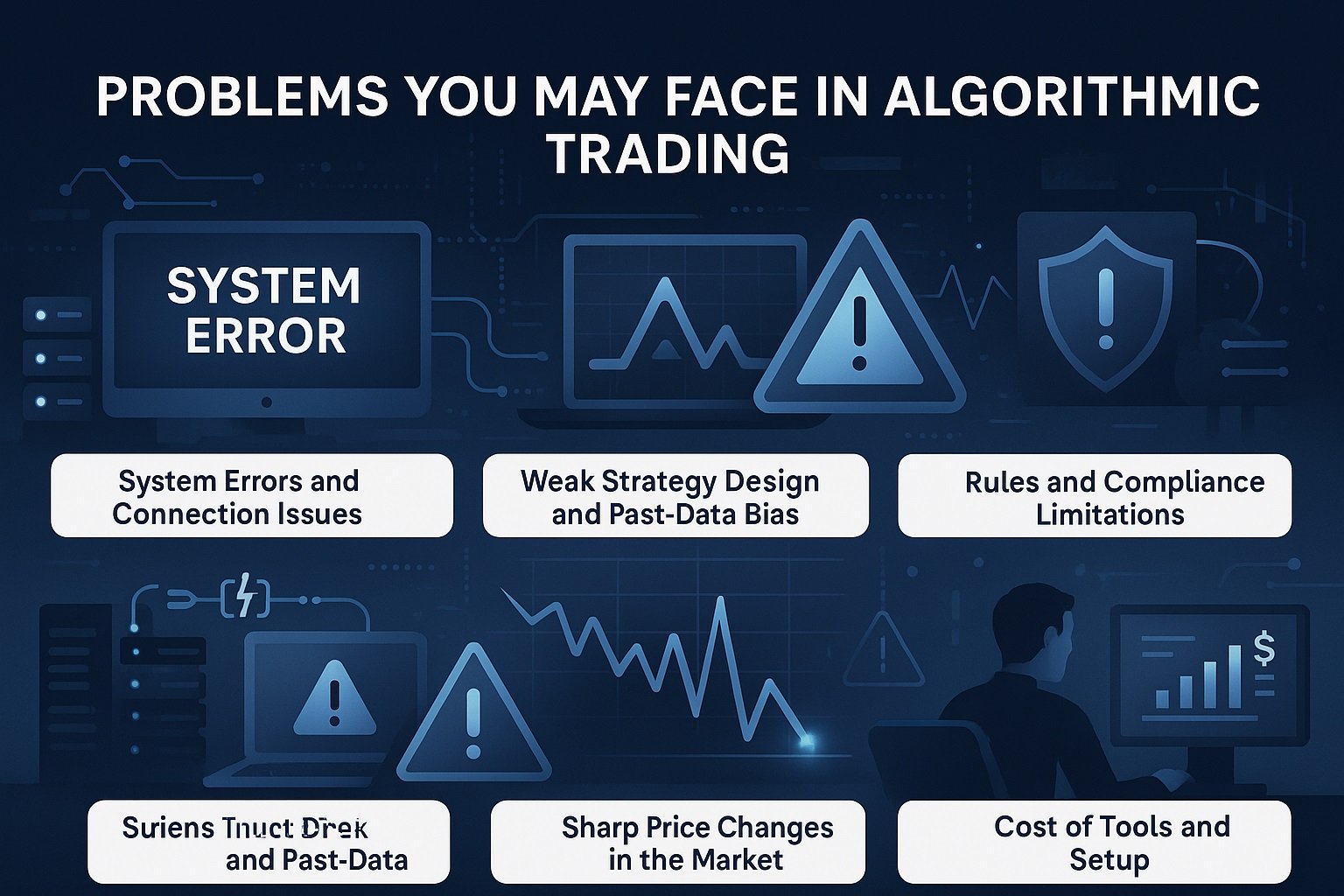
1. System Errors and Connection Issues
Algo systems rely on stable internet connections, uninterrupted data feeds and clean API responses. Any delay or connection drop can trigger wrong orders, missed entries or incorrect exits. Even small coding errors or incorrect logic can cause problems. For this reason, traders build systems with error handling, reconnection logic and monitoring tools.
2. Weak Strategy Design and Past-Data Bias
A strategy may show excellent results during backtesting but still fail in live markets. This usually happens due to overfitting, where the strategy works too well on past data but cannot adapt to new behaviour. Real-world conditions differ from historical charts, so traders must ensure the system remains steady across different phases.
3. Sharp Price Changes in the Market
Live markets can be unpredictable, especially during RBI policy updates, budget announcements, global events or high-impact news. Prices can move quickly, causing entries to slip or exits to trigger late. Risk rules such as stop loss and position limits help manage these situations.
4. Rules and Compliance Limitations
SEBI has strict rules for automated systems. Traders must tag orders correctly, follow compliance steps and use approved strategies if using exchange-certified setups. Not following rules can lead to penalties or restrictions. This makes it necessary to stay updated on regulatory changes.
5. Cost of Tools and Setup
Although beginners can start with low cost, advanced traders may invest in cloud servers, premium data, long historical datasets and low-latency setups. Professional setups often require recurring monthly expenses, which must be considered before scaling strategies.
Algorithmic Trading Broker Comparison (India, 2025)
| Broker Name | API Access Cost | Order Speed | Best For | Notes |
|---|---|---|---|---|
| Zerodha | Free | Fast | Retail traders | Stable and widely used |
| Upstox | Free | Fast | Options traders | Good for high volume |
| Angel One | Free | Moderate | New traders | Easy platform |
| Alice Blue | Paid | Very Fast | Advanced users | Good for heavy automation |
| Dhan | Free | Fast | API-focused users | Clean documentation |
Cost Overview for Algo Trading Setup in India (2025)
| Item | Estimated Cost | Description |
|---|---|---|
| Basic API Account | Free | Provided by most brokers |
| Premium Data Feed | ₹500–₹3000 monthly | For depth and faster charts |
| Cloud Server | ₹800–₹3000 monthly | For 24×7 automation |
| Backtesting Tools | Free–₹2000 monthly | Depends on the platform |
| No-Code Platforms | ₹400–₹1500 monthly | For traders without coding |
Final Thoughts
Algorithmic trading has become a strong pillar of India’s financial market. With rising retail participation, improved platforms and better access to data, anyone can learn to create automated trading systems with patience and steady practice. The real power of automated trading comes from understanding the market, creating clear rules, testing with care and managing risk with attention. Algo trading is not a shortcut, but a structured way to trade with logic instead of impulse. With the right discipline, Indian traders can use automation to improve their trading journey.
Read More: 18 Best Crypto Wallets to Use in 2025
Frequently Asked Questions About Algorithmic Trading in India
Q1. Do I need coding knowledge to start algorithmic trading?
Answer: No, coding is not required for everyone. Many beginners start with no-code or low-code platforms that allow them to create rule-based setups without writing any code. These platforms convert user-selected rules into automated systems. However, as strategies become more advanced, basic coding knowledge becomes extremely helpful. Simple Python skills can help you build custom logic, automate full workflows and test ideas in a much deeper way. Traders who want complete control, faster execution or complex systems usually choose to learn Python.
Q2. How much starting capital is needed for algorithmic trading?
Answer: There is no fixed minimum amount required to begin algo trading in India. Many traders start testing their setups with less than ₹5,000, while some begin with even smaller amounts depending on their broker’s minimum order size. It is always better to start with low capital during the testing phase because it allows you to observe how the system behaves in real markets without taking unnecessary risk. As confidence grows and the system shows steady results, traders gradually increase capital. It is also important to consider brokerage charges, exchange fees, taxes and possible losses when planning the starting amount.
Q3. Is algorithmic trading profitable for beginners?
Answer: Algorithm trading can generate good results, but it is not guaranteed profit and is not a shortcut to quick success. Profit depends on steady logic, controlled risk and regular monitoring. Beginners often make the mistake of expecting instant results or copying random strategies without proper testing. A strategy must be backtested and paper traded before using real money. Beginners who learn the basics, avoid emotional decisions, monitor their systems and keep risk levels in control have a higher chance of positive outcomes. The key is patience, discipline and a data-driven approach.
Q4. What legal rules must traders follow for algorithmic trading in India?
Answer: SEBI has introduced clear rules to ensure fair and safe use of automated systems. Any automated order must follow proper tagging standards. Platforms that offer automated setups must register with the exchanges. Some forms of automation, especially those sold commercially, require exchange approval before going live. There are rules regarding order identification, audit logs, and proper reporting. These measures protect retail traders from misleading tools and ensure transparency. Traders must stay updated with the latest circulars to avoid penalties or restrictions.
Q5. Which markets in India support algorithmic trading?
Answer: Algorithm trading is widely used in the equity, futures and options segments of NSE and BSE. It is highly popular in index derivatives such as NIFTY, Bank NIFTY and FINNIFTY due to strong liquidity and predictable behaviour. Many traders also build automated systems for stock futures and liquid stocks. Commodities and currencies on MCX and NSE also support automation through broker APIs. The availability of historical data, in-depth information and strong volumes makes these markets ideal for automated systems.