

Aggressive Hybrid Mutual Funds have slowly become a preferred choice for many Indian investors who want growth but do not want to deal with sharp market swings every few months. These funds sit between pure equity funds and conservative debt funds, offering a mix that feels balanced for long-term investing. Over the last few years, especially after volatile market phases, interest in this category has grown because investors want steadier outcomes without giving up equity exposure completely.
This article explains Aggressive Hybrid Mutual Funds in full detail. It covers how they work, how they differ from similar categories, who should invest, the risks involved, taxation rules, recent market trends, and how these funds compare with other options at a similar cost level. By the end, you should have a clear view without needing to look elsewhere.
What Are Aggressive Hybrid Mutual Funds?

Aggressive Hybrid Mutual Funds, often called Equity Hybrid Funds, are open-ended mutual fund schemes that invest in both shares and fixed-income instruments. As per current SEBI rules, these funds must keep at least sixty-five percent of their portfolio in equities, while the remaining part goes into debt and money market instruments. In most cases, equity exposure stays between sixty-five and eighty percent, while debt ranges from twenty to thirty-five percent.
This structure allows the fund to benefit from stock market growth while using debt holdings to soften sudden drops. Since shares and debt instruments usually do not move in the same direction at the same time, combining them helps smooth overall returns over long periods.
The equity portion can include large-cap, mid-cap, and sometimes small-cap stocks, depending on the fund’s style. The debt part may include government bonds, corporate bonds, treasury bills, and other short-term instruments. Fund managers regularly rebalance these holdings to stay within the required limits, so investors do not need to adjust allocations on their own.
Also Read: Earn Regular Cash Flow From Mutual Funds Using a SWP
How Aggressive Hybrid Funds Work in Real Life
In rising markets, the equity portion of these funds drives returns. When markets slow down or fall, the debt part provides support by offering steady interest income. This does not remove losses completely, but it usually reduces their intensity compared to pure equity funds.
Another benefit is automatic discipline. Many investors struggle to rebalance between equity and debt on their own. Aggressive Hybrid Funds handle this internally, following defined limits. This is useful for long-term investors who want consistency without active involvement.
Popular Aggressive Hybrid Funds in India
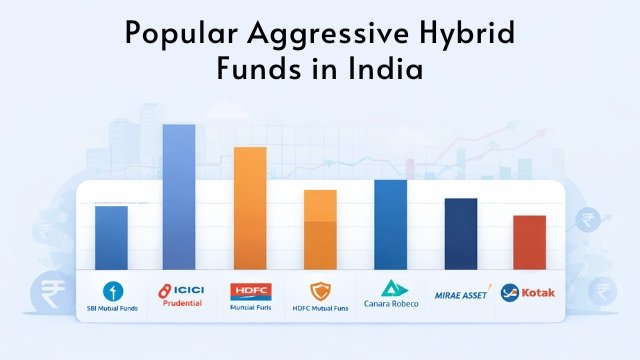
Here are some well-known Aggressive Hybrid Mutual Funds in India along with their approximate assets under management. These figures change over time and are only for general understanding.
| Scheme Name | AUM (₹ Crore) |
|---|---|
| SBI Equity Hybrid Fund | 8,195 |
| ICICI Prudential Equity & Debt Fund | 48,000+ |
| HDFC Hybrid Equity Fund | 24,600+ |
| Canara Robeco Equity Hybrid Fund | 11,400+ |
| Mirae Asset Aggressive Hybrid Fund | 9,400+ |
| Kotak Aggressive Hybrid Fund | 8,400+ |
| Aditya Birla Sun Life Equity Hybrid Fund | 7,500+ |
The schemes listed above are examples only and not recommendations.
Also Read: 20 Best Small Cap Mutual Funds in India
Aggressive Hybrid Funds vs Balanced Advantage Funds
Aggressive Hybrid Funds and Balanced Advantage Funds often confuse investors because both invest in equity and debt. The main difference lies in how rigid or flexible the allocation rules are.
Aggressive Hybrid Funds follow fixed allocation limits. They must always keep at least sixty-five percent in equity, no matter how expensive or cheap the market looks. This makes them closer to equity funds in behavior, especially over long periods.
Balanced Advantage Funds, on the other hand, can change equity and debt exposure based on market levels. Some schemes may reduce equity sharply when markets look expensive and increase debt holdings instead. When valuations improve, they move back into equities.
In practice, many Balanced Advantage Funds still keep equity exposure close to sixty-five percent to qualify for equity taxation. Because of this, the difference between the two categories is sometimes smaller than expected. Still, Aggressive Hybrid Funds are simpler and easier to understand, as their structure remains largely stable.
Why Investors Choose Aggressive Hybrid Mutual Funds

One major reason investors choose Aggressive Hybrid Funds is simplicity. With a single fund, they get access to two asset classes. This removes the need to track and manage multiple funds separately.
Another reason is smoother performance. While these funds can fall during market corrections, the presence of debt usually limits the downside compared to pure equity funds. This makes them suitable for investors who feel uneasy with sharp drops but still want equity exposure.
Aggressive Hybrid Funds are also helpful for goal-based investing. Long-term goals like retirement planning, child education, or wealth building over ten to fifteen years fit well with this category, especially for investors with moderate to moderately high risk comfort.
Also Read: 10 Best Mutual Funds in India 2026
Risks Involved in Aggressive Hybrid Mutual Funds
Although these funds are less volatile than pure equity funds, they are not risk-free. Since equity forms the majority of the portfolio, market corrections can still impact returns in the short term. Investors should be ready to stay invested during such phases.
Another point to note is that during strong bull markets, Aggressive Hybrid Funds may lag behind pure equity funds because part of the money stays invested in debt. This trade-off is the cost of reduced swings.
Debt investments also carry interest rate risk and credit risk, though most funds focus on high-quality instruments to limit issues. Choosing funds with a strong track record and experienced management helps manage these concerns.
Tax Treatment of Aggressive Hybrid Funds

Aggressive Hybrid Mutual Funds are treated as equity-oriented funds for tax purposes because they maintain more than sixty-five percent exposure to equities.
If units are sold within twelve months, gains are treated as short-term capital gains and taxed at twenty percent.
If units are sold after one year, gains are treated as long-term capital gains. Tax applies at twelve and a half percent, but only on gains above ₹1.25 lakh in a financial year. This makes them more tax-friendly compared to most debt-oriented funds for long-term investors.
Recent Trends and Market Context
In recent years, Indian investors have shown growing interest in hybrid categories due to repeated market swings, rising interest rates, and global uncertainty. Many first-time investors entering mutual funds also prefer balanced options over pure equity funds.
Fund houses have improved risk management and portfolio quality, especially on the debt side. This has added confidence among investors who were earlier worried about credit-related issues.
Systematic investment plans in Aggressive Hybrid Funds have also increased, as they allow investors to average costs over time while staying invested through market cycles.
Also Read: Best Categories of Mutual Funds to Invest in 2026
Who Should Invest in Aggressive Hybrid Mutual Funds?

Aggressive Hybrid Funds suit investors who want equity growth but are not comfortable with extreme ups and downs. They are suitable for those with a time horizon of at least five to seven years.
These funds can also work well for investors transitioning from debt to equity, as well as for those nearing major financial goals who want to reduce volatility gradually without exiting equities fully.
Expense Ratios and Cost Comparison
Aggressive Hybrid Funds usually have expense ratios lower than pure equity funds but higher than debt funds. Direct plans typically offer lower costs compared to regular plans.
Here is a general comparison of expense ratios across categories.
| Fund Type | Typical Expense Ratio |
|---|---|
| Aggressive Hybrid Funds | 0.7% – 1.2% |
| Pure Equity Funds | 1.0% – 1.5% |
| Balanced Advantage Funds | 0.8% – 1.3% |
| Debt Funds | 0.3% – 0.7% |