
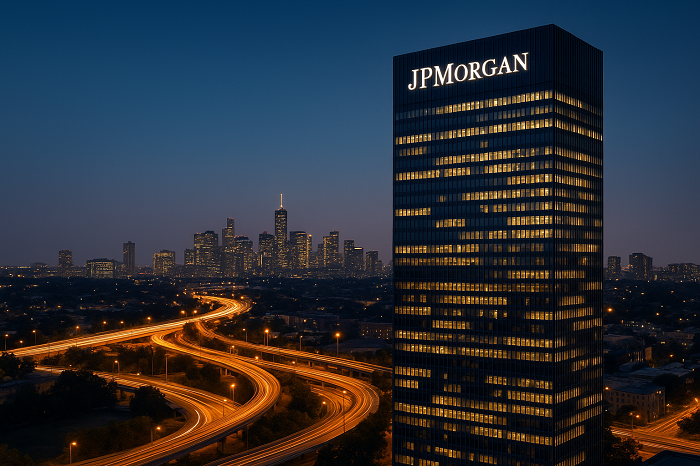
When the world’s largest bank makes a trillion-dollar move, markets pay attention. JPMorgan Chase’s recent announcement of a $1.5 trillion, decade-long investment initiative has sent waves across global finance. Framed as a bold step toward strengthening U.S. national security and economic resilience, the initiative is designed to finance and invest in industries that form the backbone of strategic strength — from advanced manufacturing and defense to renewable energy and frontier technologies.
But this isn’t just another corporate investment plan. It represents a structural shift in how major financial institutions see their role in a geopolitically fragile, post-pandemic world. JPMorgan’s “Security and Resiliency Initiative” is not merely about profit; it’s about power, positioning, and the reshaping of global capital flows.
Why JPMorgan Is Making This Massive Bet
The roots of this initiative lie in the vulnerabilities exposed by the last few years. The pandemic, supply-chain bottlenecks, and mounting geopolitical tensions — especially between the U.S. and China — revealed how dependent nations had become on fragile, globalized systems. Critical sectors such as semiconductors, energy infrastructure, and rare-earth mining suddenly became national priorities.
JPMorgan, recognizing both the risks and opportunities, is now responding with a financial strategy that aligns with national interests. Initially, the bank had planned to facilitate around $1 trillion in strategic financing over the next decade. The revised target of $1.5 trillion significantly amplifies that commitment, marking one of the most ambitious private-sector investment agendas in history.
What makes this move unique is its structure. JPMorgan will not simply act as a lender; it will become an active participant — a financier, an advisor, and in some cases, an investor. A portion of the plan includes $10 billion in direct equity and venture investments, signaling that the bank intends to take a hands-on role in shaping emerging sectors and startups that could redefine economic resilience in the years to come.
The Focus Areas: Building the Backbone of Resilience
Rather than spreading capital thinly across the financial landscape, JPMorgan is concentrating its firepower on four broad categories: supply-chain and manufacturing resilience, defense and aerospace, energy independence, and strategic technologies.
Under supply-chain resilience, the bank aims to support industries like battery manufacturing, robotics, shipbuilding, and critical minerals — all essential to reducing dependence on foreign production. The defense and aerospace segment will include investments in secure communications, advanced avionics, and defense components, aligning closely with U.S. industrial policy.
Energy independence is another pillar, encompassing nuclear energy, renewable power, and grid-level storage — sectors that are not only vital for sustainability but also for shielding national infrastructure from external shocks. Lastly, JPMorgan will target frontier technologies such as artificial intelligence, quantum computing, nanomaterials, and cybersecurity, areas that define the technological edge of future global competitiveness.
Each of these categories represents more than a business opportunity. They embody strategic priorities that intersect economics, innovation, and geopolitics. JPMorgan’s bet effectively positions it at the crossroads of finance and national strategy — a place no private bank has occupied at such scale in recent memory.
1. How This Affects Global Finance
The global implications of JPMorgan’s $1.5 trillion plan are enormous. This is not merely a U.S.-focused program; it will reshape how capital moves, how industries evolve, and how nations compete.
The first major consequence will be a reallocation of global capital. Traditional sectors that have long attracted corporate financing — such as fossil fuels and mature manufacturing — may see slower inflows, while funds increasingly shift toward infrastructure, clean energy, and emerging technologies. This could alter stock valuations, corporate borrowing costs, and even the structure of global bond markets.
Institutional investors are likely to recalibrate their portfolios around these “resilience-driven” themes. As a result, risk assessment models could start incorporating new variables, such as geopolitical exposure and supply-chain vulnerability. In other words, resilience will become a financial metric, not just a policy buzzword.
Another ripple effect will be seen in public-private cooperation. JPMorgan’s move aligns closely with the U.S. government’s industrial policy push to rebuild domestic capacity. Similar trends may soon follow in Europe, India, and East Asia, where governments are encouraging private capital to fund defense, green energy, and technology ecosystems. In this sense, JPMorgan’s initiative could trigger a global wave of strategic investment arms, each tied to national goals.
2. The Competitive and Strategic Dimension
This initiative also creates competitive pressure within the financial industry itself. Other multinational banks — from Goldman Sachs and Citi to European and Asian giants — will face growing expectations to launch similar long-term, mission-driven funds. What JPMorgan is effectively doing is rewriting the playbook for global banking leadership: from transactional finance to strategic finance.
By positioning itself at the forefront of sectors that will define the next industrial revolution, JPMorgan isn’t just betting on companies — it’s betting on the future architecture of the world economy. This is also a reputational move. The bank is signaling to investors, clients, and policymakers that it wants to be a core player in building what comes next: secure supply chains, green energy networks, and technology sovereignty.
3. Challenges and Risks Ahead
However, this ambitious plan is not without risk. Managing investments across twenty-seven sub-sectors will require deep technical expertise, and JPMorgan will need to recruit or partner with specialists to ensure that capital is effectively deployed. Execution risk is significant; even small missteps could have reputational or financial repercussions.
Political volatility adds another layer of uncertainty. Since many of these industries depend on regulatory approval, trade policy, or government incentives, any shift in leadership or policy direction could alter the playing field. For example, a change in administration could modify subsidy structures, environmental regulations, or defense budgets, directly affecting profitability and investment flows.
Moreover, the global context cannot be ignored. The initiative’s U.S.-centric focus may be perceived as protectionist by other countries, potentially fueling retaliatory industrial policies or trade restrictions. Balancing national alignment with international cooperation will therefore be one of JPMorgan’s most delicate tasks.
4. What JPMorgan Stands to Gain
Despite the risks, the rewards could be transformative. If successful, JPMorgan will not only generate strong financial returns but also entrench itself as an indispensable partner in shaping the economic and technological landscape of the coming decades. Its involvement in critical industries could grant it unparalleled influence over infrastructure, innovation, and global development projects.
This approach also provides the bank with a long-term hedge against cyclical downturns. By investing in sectors tied to strategic imperatives rather than consumer trends, JPMorgan diversifies its portfolio against short-term volatility. And perhaps most importantly, it strengthens its brand as a leader in the evolving nexus of finance, national security, and technology.
5. A New Era of Strategic Finance
JPMorgan’s $1.5 trillion bet symbolizes a larger shift taking place in global finance. The age of pure financial globalization — where capital simply chased yield — is giving way to a new era where capital follows strategy. Banks are becoming architects of resilience, not just intermediaries of liquidity.
In the coming years, we can expect to see similar initiatives across other major economies. The European Union’s Green Deal, India’s “Make in India” policy, and China’s drive for technological self-sufficiency all reflect the same underlying trend: finance as an instrument of national strength. JPMorgan’s move is merely the most visible and ambitious manifestation of this paradigm.
Final Thoughts
JPMorgan’s massive $1.5 trillion initiative is more than a financial commitment — it’s a declaration of intent. By tying its long-term strategy to the world’s most critical sectors, the bank is positioning itself not just as a market participant but as a geopolitical force.
This could redefine what it means to be a global financial leader in the 21st century. The future of banking will no longer be about short-term lending and quarterly profits, but about shaping the very systems that sustain economies and nations.
For investors, policymakers, and global observers, JPMorgan’s bet is a signal worth watching — not just for what it says about the bank’s vision, but for what it reveals about where the world economy is headed.
Frequently Asked Questions
Q1. What is JPMorgan’s $1.5 trillion initiative about?
Answer. It’s a decade-long plan to finance and invest in industries crucial to U.S. national security and economic resilience, including advanced manufacturing, energy, defense, and emerging technologies.
Q2. How will the $1.5 trillion be used?
Answer. Most of it will be deployed through loans, financing, and underwriting, while around $10 billion will go into direct equity and venture investments in strategic companies.
Q3. Why is JPMorgan focusing on these sectors?
Answer. These industries are seen as vital for supply-chain independence, technological leadership, and national defense — areas increasingly important in a geopolitically uncertain world.
Q4. What impact will this have on global markets?
Answer. The initiative could redirect global capital flows, influence valuations in strategic industries, and accelerate a broader trend toward public-private cooperation in industrial investment.
Q5. What are the major risks?
Answer. Key risks include regulatory delays, policy changes, execution challenges, and geopolitical backlash from countries that see this U.S.-centered initiative as protectionist.
Disclaimer:
This article is intended solely for informational and educational purposes. It should not be interpreted as financial, investment, banking, or trading advice. The analysis provided is based on publicly available information at the time of writing, and global financial conditions, corporate strategies, and geopolitical dynamics may change over time. We are not registered with SEBI, RBI, IRDAI, or any financial regulatory authority. Readers should conduct their own research and consult a qualified financial advisor before making any investment or strategic decisions related to banking, global markets, or institutional finance.