
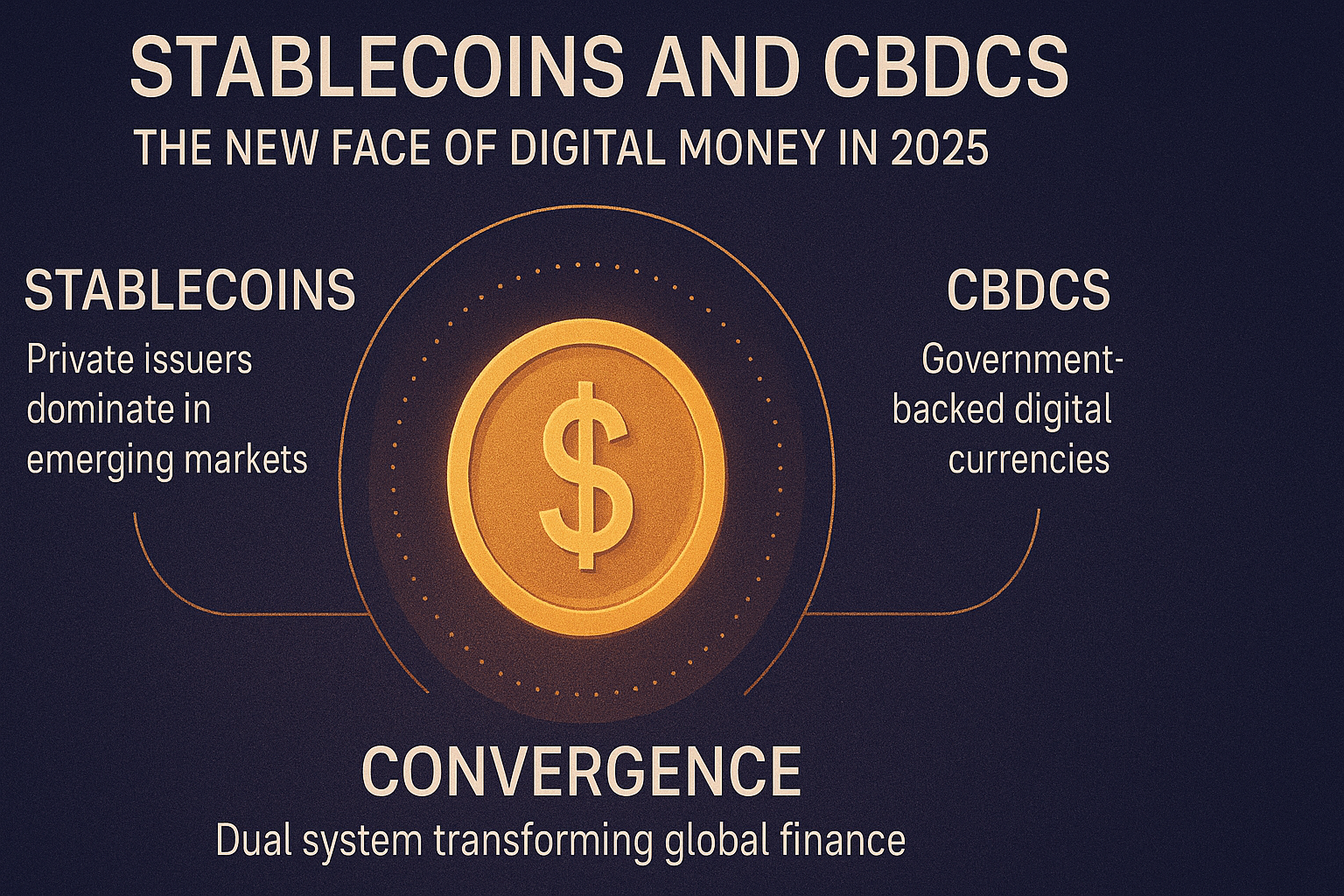
In 2025, digital money has officially gone mainstream. The world’s financial systems are being redefined by two powerful forces
The Rise of Stablecoins
Stablecoins — cryptocurrencies pegged to fiat currencies like the U.S. dollar or the euro — have become the backbone of the digital economy. Projects such as USDC, Tether (USDT), and PayPal USD dominate online commerce, decentralized finance (DeFi), and cross-border transactions.
Their success stems from three key advantages:
-
Instant global transfers without banking intermediaries.
-
Transparency through blockchain audits.
-
Accessibility for unbanked populations in emerging markets.
In countries like Argentina, Nigeria, and Turkey, stablecoins have become everyday tools for preserving purchasing power amid inflation. For businesses, they’re the preferred method of international settlement, reducing transaction costs by up to 70.
Stablecoins and Central Bank Digital Currencies (CBDCs). Once seen as rivals, these two innovations are now converging, forming a hybrid system that blends decentralization with regulation.
This dual-track evolution is transforming everything from remittances to trade settlements and even how individuals interact with money.
The Global Rise of CBDCs
Parallel to stablecoin growth, governments have accelerated the rollout of Central Bank Digital Currencies. Over 90 countries are now in advanced stages of CBDC development.
-
The Digital Dollar (FedCoin) is in limited pilot with major U.S. banks.
-
The European Central Bank has launched the Digital Euro for retail use.
-
India’s e-Rupee and China’s e-CNY have achieved mass adoption.
Unlike stablecoins, CBDCs are state-backed, offering legal tender status and integration into national monetary policies. They promise increased transparency, reduced fraud, and enhanced financial inclusion.
However, critics warn of privacy trade-offs governments could potentially track transactions with precision. To mitigate this, hybrid CBDC models are emerging, balancing traceability with user privacy through selective encryption.
The Great Convergence: Stablecoins + CBDCs
Rather than competing, stablecoins and CBDCs are converging. Financial institutions are developing interoperable payment rails allowing both forms of digital money to coexist.
For instance:
-
Cross-border settlements use stablecoins for speed and CBDCs for compliance.
-
Corporate treasuries blend CBDCs with stablecoins to optimize liquidity.
-
Smart contracts can now handle both assets seamlessly in multi-currency DeFi protocols.
This convergence is giving rise to what economists call “programmable finance” — money that can execute itself based on rules and conditions embedded in code.
Impact on the Global Economy
The implications are profound:
-
Faster, cheaper remittances are reducing global inequality.
-
Supply chain financing is being automated through tokenized settlements.
-
Trade finance between Asia, Europe, and Africa is moving to blockchain rails.
-
And financial inclusion is expanding as digital wallets become universal.
Banks, rather than resisting, are adapting — issuing their own tokenized deposits compatible with both stablecoin and CBDC networks.
Challenges and Outlook
Despite progress, challenges remain:
-
Interoperability standards between private and public systems are still evolving.
-
Cybersecurity and privacy protections must strengthen to prevent misuse.
-
Regulatory clarity is needed for cross-border transactions involving digital currencies.
Still, the momentum is unstoppable. Analysts project that by 2027, over half of global digital payments will involve either a stablecoin or a CBDC.
Conclusion
The digital money revolution is no longer theoretical — it’s here. Stablecoins bring agility, innovation, and user empowerment. CBDCs bring trust, regulation, and stability. Together, they are reshaping the global financial architecture into one that is faster, smarter, and more inclusive.
The question isn’t whether digital money will dominate — it’s how soon the rest of the world catches up.